Too powerful to touch: Sudan's war keeps pointing at Abu Dhabi, and nobody acts
UN investigators say a network tied to the Emirates has fed weapons, drones and fighters to the RSF. Amnesty found the hardware on the ground. Abu Dhabi denies all of it, and between a record oil field and a football club found guilty on 114 charges, no institution has yet laid a glove on the state at the centre of the story.
Darfur, Sudan · October 22, 2026
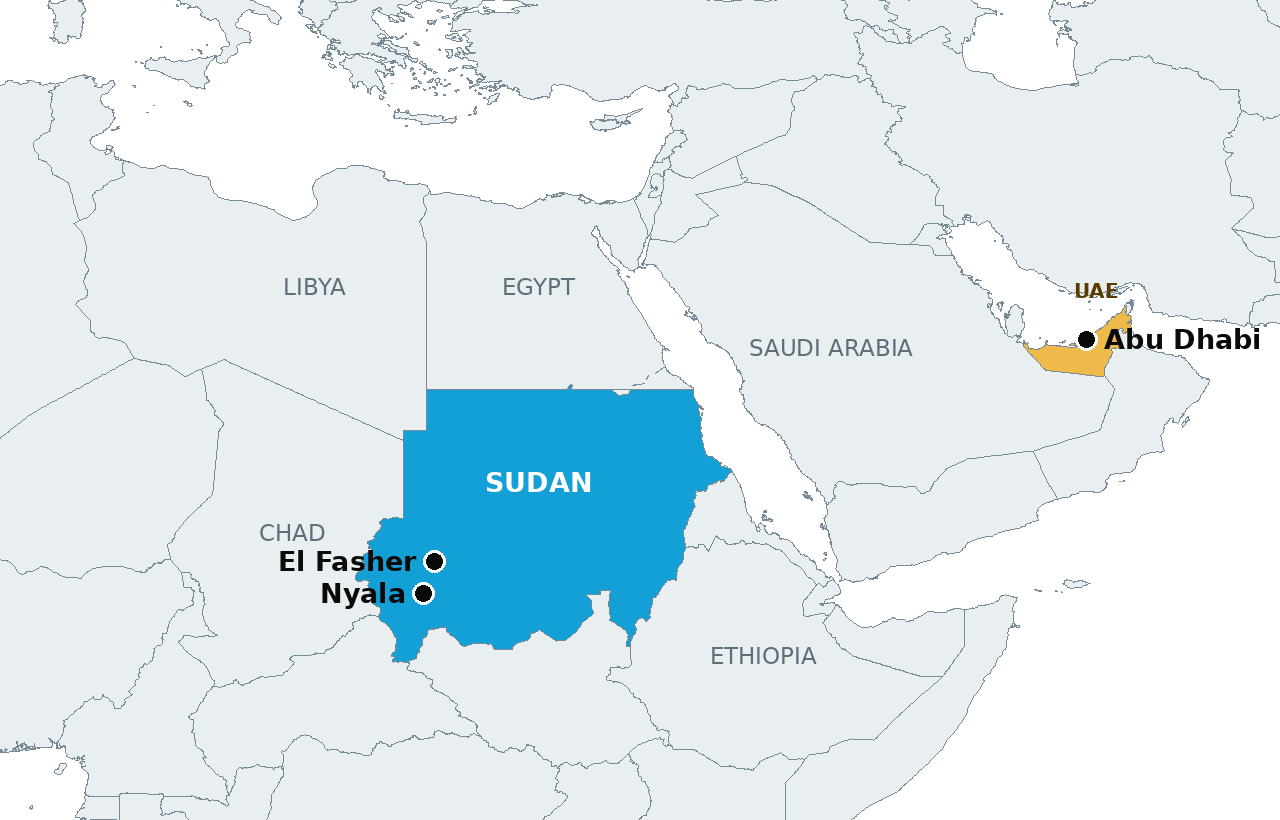
Fourteen million people have fled their homes in Sudan, more than in any other war on earth right now, and the fighting still is not burning itself out. Wars this size usually fade when the money and the weapons run dry. This one has not faded, and in September the United Nations offered an explanation for why. Its fact finding mission on Sudan said there were reasonable grounds to believe that a transnational network has been supplying the Rapid Support Forces, the paramilitary army fighting Sudan's military since April 2023, with weapons, logistics, training and foreign fighters. The network ran through Chad, Libya and Somalia. And persons and entities linked to the United Arab Emirates, the mission said, played a significant role in it.
Start with the war itself, because the supply lines only matter against what they are feeding. Sudan has split roughly in two. The army holds Khartoum, which it retook in March 2025, along with the north, the east and the centre. The RSF holds almost all of Darfur in the west and parts of Kordofan, and it is pushing east, towards El Obeid and on towards Damazin in Blue Nile state. El Fasher, the army's last stronghold in Darfur, fell last October after a siege of about eighteen months, and the UN mission has said the conduct around its capture displayed hallmarks of genocide, a charge Washington had already levelled at the RSF in a formal determination in January 2025. Drone strikes by both sides killed more than 1,000 people in the first five months of this year alone. This is not a frozen conflict waiting for diplomats. It is an active war moving across the map, and wars that move need feeding.
The feeding, on the investigators' account, is organised. The UN mission identified Nyala airport in South Darfur as a principal entry point, and described routes that loop wide around Sudan rather than crossing its borders directly: through Amdjarass in eastern Chad, where an earlier UN panel counted at least 24 cargo flights in a year, several of them departing Emirati airports and dropping off radar mid flight; through Kufra in eastern Libya; and through Bosaso in Somalia's Puntland. It also found that up to 2,000 former Colombian military contractors had operated RSF drones, artillery and air defence, some of them present around El Fasher as it fell. A supply chain with that many stops is not an accident of geography. It is built to be deniable, one border at a time.
Then there is the hardware, which is harder to explain away than a flight path. Amnesty International reported in May 2025 that Chinese made GB50A guided bombs and 155mm AH-4 howitzers, both built by the state owned Norinco group, had turned up in RSF hands in Darfur and Khartoum. It was the first documented combat use of the GB50A anywhere in the world. The howitzer is the detail that sticks: according to the Stockholm International Peace Research Institute data Amnesty relied on, the only country that has ever imported the AH-4 is the UAE, which bought it in 2019. Weapons do not re-export themselves, and Amnesty concluded the systems were almost certainly re-exported to Sudan by the Emirates, in breach of the UN arms embargo on Darfur. Abu Dhabi answers all of this in one voice, and it has not changed: it rejected the UN mission's findings as a false media campaign, officials have told Reuters there is no substantiated evidence that the UAE has provided arms or support to the RSF, and its UN mission says the Emirates is not involved in Sudan's civil war. Those denials are on the record and they matter. So does the care in the UN mission's own wording: it tied persons and entities to the Emirates, and stopped short of attributing the network's conduct to the Emirati state itself.
Follow the money out and the picture tightens rather than loosening. Gold is Sudan's wartime currency, much of it dug in ground the RSF controls, and the Swiss group Swissaid, working from UN trade data, found that the UAE imported 29 tonnes of gold directly from Sudan in 2024, up from 17 tonnes the year before, with more arriving routed through Chad and Libya, the same corridors the weapons are said to travel in the opposite direction. The Sentry, a US investigative group, mapped more than a dozen RSF linked firms operating in the UAE, gold traders among them, and put its conclusion in one sentence: the RSF cannot wage war without money. None of this has produced a measure against the Emirati state. Washington has sanctioned individual UAE based companies accused of channelling money and equipment to the RSF, and the UN Security Council has sanctioned two men in the Colombian recruitment network, but the Council stays split over widening the Darfur arms embargo to the whole country, and no government has moved against Abu Dhabi itself.
The leverage is not hard to see, and September put a number on it. The Emirates walked out of OPEC and its wider alliance in May, effective May 1, freeing itself from the output caps it had chafed under for years. By September, the International Energy Agency counted total Emirati oil production at a record 5.3 million barrels a day, with crude above 4.4 million, close to the country's maximum capacity, achieved while tanker traffic through the Strait of Hormuz was still recovering from the Iran war. The state oil company ADNOC is in the middle of a 150 billion dollar investment programme. A country pumping at a record rate, holding a fifth of the world's spare breathing room on energy and selling into a market frightened of shortages, does not get sanctioned on a human rights timetable. It gets courted.
Which is why the second half of this story is set in Manchester. The same ruling family sits behind Manchester City: the club's parent group is 81 percent owned by Abu Dhabi United Group, the vehicle of Sheikh Mansour bin Zayed Al Nahyan, a member of Abu Dhabi's ruling family and a vice president of the UAE. Last month an independent commission found City guilty on 114 of the Premier League's 115 charges, centred on more than 830 million pounds of owner funding that the commission found had been presented as sponsorship revenue across nine seasons, from 2009/10 to 2017/18. City deny wrongdoing, lodged their appeal on October 1 calling the verdict unsafe, and point to what they call a comprehensive body of irrefutable evidence in their support. The punishment, meanwhile, is zero: no points deducted, no fine, no titles touched, with sanctions left to a separate hearing that is not expected to produce an outcome during this season. City sit top of the league, seven wins from seven, and the season rolls on around the verdict as if it were weather. We covered the widening case against the club, including the accounting watchdog's examination of its auditors, in our Sport section this week.
Put the two halves side by side and the pattern is the story. In Sudan, a UN mission assembled a supply chain, a rights group identified the weapons down to their model numbers, and trade data traced the gold, and the sum of consequences for the state named at every turn is a round of denials. In England, a commission heard the biggest financial case in Premier League history and returned 114 guilty findings, and the sum of consequences so far is an appeal and a fixture list. Different continents, different institutions, same gap between finding and consequence. That gap is not evidence of innocence in either case, and it is not proof of guilt beyond what the findings themselves say. It is a measure of what enforcement costs when the accused can offer oil, capital, a global football brand and a harbour on the Gulf, and when everyone doing the enforcing needs at least one of those things.
Our call is that the gap holds through the winter, and the order of events will tell you everything. No state level measure against the Emirates lands before City's appeal is heard, because no government wants to open a second front against Abu Dhabi while the first is still being argued by lawyers, and the Security Council's split over a nationwide embargo gives every capital that wants one a ready excuse to wait. Watch two dates rather than the statements: the sanctions hearing in the City case, where a points deduction deferred to a future season would confirm that even a guilty verdict gets scheduled around the football calendar, and the next UN panel report on Sudan, where the test is whether the wording climbs the one rung it has so far avoided, from persons and entities linked to the Emirates to the Emirati state itself. If that rung is ever climbed, the denials stop being the end of the story. Until then, fourteen million displaced people are living inside the difference between what investigators can prove and what anyone is willing to do about it.
The Briefing
The day's world, market and sport, measured and in your inbox before breakfast. One email, no noise, free while we build it.
Subscribe by emailSubscribing opens your email app with a note to [email protected]. We never share your address.