The Congo war, explained: a former president takes the rebellion, and the minerals pay for the fighting
Goma and Bukavu answer to a rebellion, not to Kinshasa. This month Joseph Kabila took command of it in Goma itself, and underneath the politics sits a loop of coltan and gold that pays the war's bills.
Goma, Democratic Republic of Congo · October 24, 2026
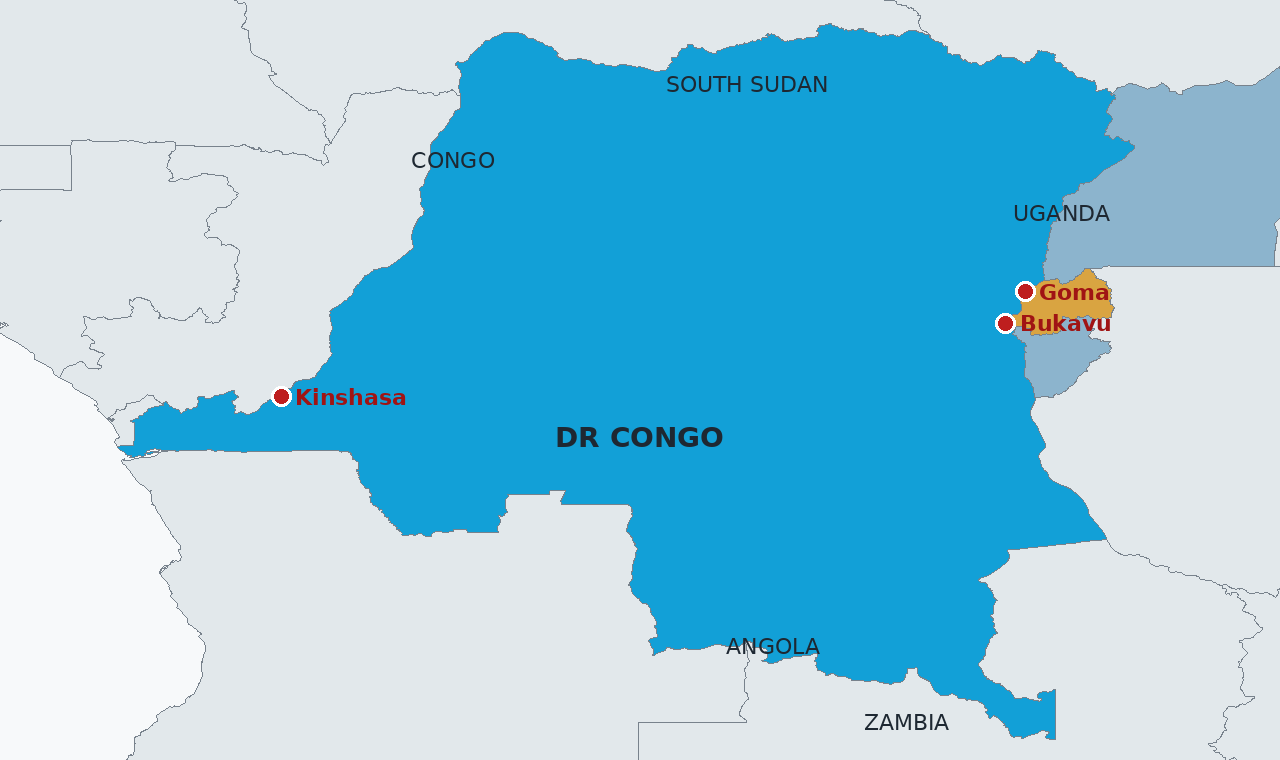
Two of the biggest cities in eastern Congo answer to a government that is not the one in Kinshasa. Goma and Bukavu, the capitals of North and South Kivu, are run by a rebellion, and this month the rebellion got a new commander. Joseph Kabila, who ruled Congo for 18 years, took charge of it on October 12 in Goma itself, at the head of a new front that has absorbed the old M23 alliance. Peace deals have been signed in Washington and in Doha. The shooting has not stopped.
The map explains why nobody can simply order it to stop. The rebels hold both capitals and a wide stretch of countryside around them. Government troops hold the south around Uvira, backed by Burundian soldiers and local militias called the Wazalendo, and in the Masisi hills and the South Kivu highlands villages still change hands. Behind every line there are people: more than six million Congolese have been driven from their homes, and the camps around the cities grow with each round of fighting.
The cast is what makes this war so hard to end. On one side stands Congo's own army, held up by Burundi, which has rotated more than 29,000 soldiers across the border since 2022 under a security deal with Kinshasa. On the other side stand the M23 rebels and their political partners, now flying Kabila's flag. Behind the rebels, UN experts say, stands Rwanda's army: between 14,000 and 18,000 Rwandan soldiers inside Congo, some wearing rebel uniforms, in mixed battalions taking orders that run back to Kigali, with drones, GPS guided mortars and jammers in support. Rwanda denies all of it. Up in Ituri, Uganda fights a separate war beside Kinshasa against the ADF, a group tied to Islamic State, and UN peacekeepers are still on the ground, mandated only until December.
The weapons arrive by every route a war can find. Rwanda's soldiers bring theirs with them across the border. Kinshasa has gone shopping instead: Chinese and Turkish combat drones, Emirati armoured vehicles, a defence pact with Serbia, and gear reportedly flown in through Bujumbura airport in Burundi. And the oldest supply line of all is the battlefield itself. Every depot that changes hands hands its weapons to the winner, so even a lost battle restocks the side that took the ground.
What pays for all of it sits under the rebels' feet. At Rubaya, miners dig coltan, the ore inside your phone, at more than 120 tonnes a month. The rebels tax every kilo, trucks roll east into Rwanda, and Congolese ore is mixed with Rwandan production and sold to the world: at least 1,400 tonnes were smuggled across in the year after Rubaya fell. Gold from the rebel held areas moves the same way, to a Kigali refinery the United States sanctioned in June. Minerals out, money back, money buys guns.
Our call is that this war will not be talked to death in Washington or Doha, because it does not need anyone's permission to keep going: it pays its own bills. Every agreement so far has asked the armies to stop while leaving the mineral loop that funds them untouched, and Kabila's arrival makes the politics harder still, because a former president whom Kinshasa sentenced to death in absentia last year has no safe road back to civilian life and therefore no reason to trade his army for promises. The deal that ends this war will be the one that prices the coltan and the gold, through traceability buyers actually enforce and a cut of the trade for the east that is legal and visible. Until then, expect the front to move with the price of the minerals under it, not with the calendar of summits.
The Briefing
The day's world, market and sport, measured and in your inbox before breakfast. One email, no noise, free while we build it.
Subscribe by emailSubscribing opens your email app with a note to [email protected]. We never share your address.