The Eagle's Nest has burned almost to the ground, and Germany now has to decide what a warning is worth
Fire took the Kehlsteinhaus above Berchtesgaden on Friday night, the mountain retreat built for Hitler that postwar Germany kept standing on purpose, as a monument and a lesson. Around 200 firefighters could not save it. A suspect is detained, and the harder question is what, if anything, should rise in its place.
Berchtesgaden, Germany · October 24, 2026
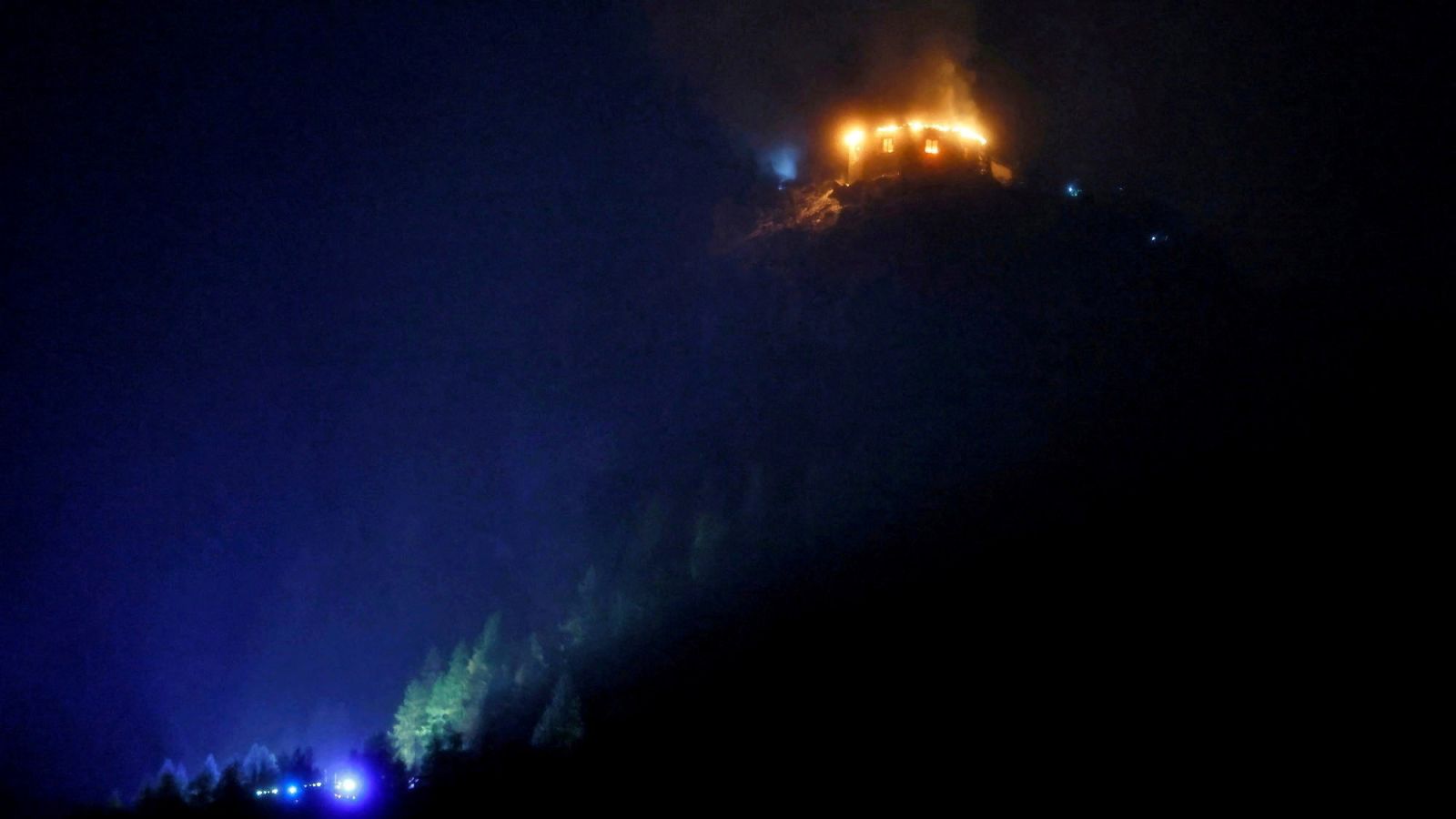

The alarm went off at about 9:15 on Friday night, and by the time crews reached the top of the mountain the building was already ringed in flames. The Kehlsteinhaus, the retreat the world knows as the Eagle's Nest, sits on a cliff 1,834 metres above Berchtesgaden in the Bavarian Alps, at the end of a single road that climbs through five tunnels. Around 200 firefighters and emergency workers fought the fire into Saturday morning, some of them able to approach only in breathing apparatus. Nobody was inside the building, which was closed that day, and nobody was hurt. Police said later that it had burned down almost completely.
A person was detained near the scene shortly after the fire began and is under investigation, with police examining whether the fire was set deliberately. The cause has not been established and no motive has been announced, and that distinction matters: a detention in the first confused hours is a line of inquiry, not an answer. What investigators can say is that a building which survived a war, and was deliberately preserved after it, was destroyed in a single night at the start of the tourist off season.
The building was completed in 1938, commissioned by Martin Bormann as a birthday present for Adolf Hitler, who in the event visited it only rarely. Its real purpose was theatre: a tea house on a cliff edge, reached by a marble lined tunnel and a brass elevator drilled through the rock, built to impress visiting dignitaries with the reach of the regime. After the war it passed to the state of Bavaria, which kept it standing and classified it as a historical monument recalling the Nazi period. Since 1952 it has worked as a mountain restaurant with an exhibition on its own history, which is the compromise Germany chose: the building stays, but it has to explain itself.
That compromise is why the fire is a bigger story than a lost landmark. Germany's way with the physical remains of the dictatorship has always been deliberate. Some sites were demolished, some were buried under car parks, and a few, like this one, were kept in plain sight and wrapped in documentation, on the theory that a country should be able to stand in the room where it happened. The local tourism authority said on Saturday that it was not yet clear whether any part of the building could be salvaged.
What happens next runs on two tracks. The police investigation will decide whether this was arson, and if it was, who set it and why. Then Bavaria has to choose among three futures for the site: a faithful rebuild, a preserved ruin, or a memorial that keeps the footprint and the exhibition and lets the building itself go. Each choice says something different about what the place was for.
Our call is that Bavaria will not rebuild it as it stood, and should not. A perfect replica would hand back the photograph the regime designed, the tea house on the cliff, and strip away the one honest thing the original still carried, which was its survival as evidence. Expect the harder and better answer instead: the ruins stabilised, the tunnel, the elevator shaft and the exhibition kept, and the scar left visible from the valley. A warning that has burned once can still warn. It just cannot pretend the night never happened.
The Briefing
The day's world, market and sport, measured and in your inbox before breakfast. One email, no noise, free while we build it.
Subscribe by emailSubscribing opens your email app with a note to [email protected]. We never share your address.