The weapons are traced and the gold is counted: the case against Abu Dhabi in Sudan
UN investigators, Amnesty and the US Treasury have spent three years building a file on the Emirates and the RSF: flights, howitzers, lot numbers, tonnes of gold. The file keeps growing. The consequences do not exist. This is that file, and the price of the silence around it.
Darfur, Sudan · October 22, 2026

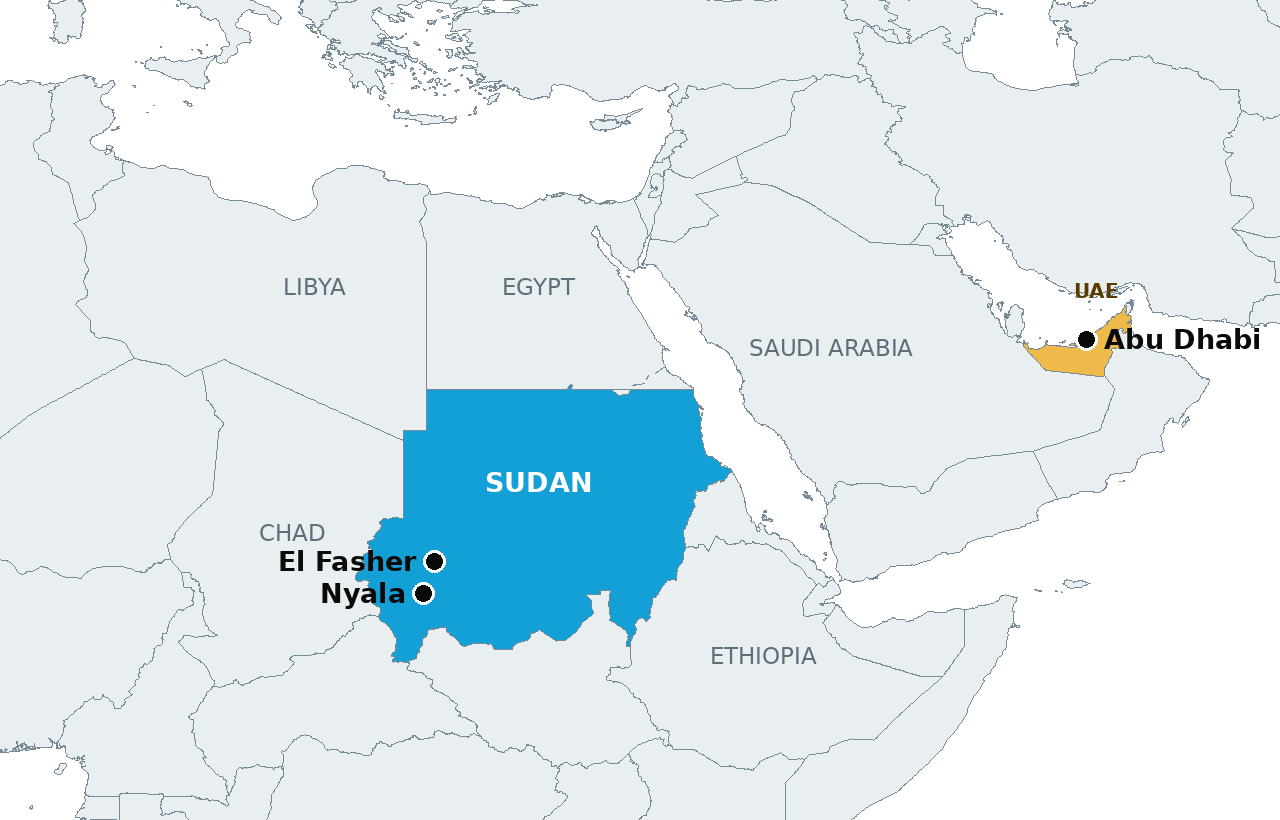
El Fasher fell on October 26, 2025. The capital of North Darfur had been besieged for eighteen months by the Rapid Support Forces, in open defiance of a UN Security Council resolution that demanded the siege be halted, and when the city finally broke, the men operating the drones and artillery in RSF colours included, on the evidence of two separate UN investigations, hundreds of hired Colombians who had arrived through a pipeline run from the Gulf. Fourteen million Sudanese have now fled their homes, the largest displacement on earth. More than thirty million need aid to survive. Famine has been formally declared. And the question that will occupy historians of this war is not who supplied it. The supply lines are documented in unusual detail, by UN investigators, by Amnesty International, by the United States Treasury. The question is why the documentation changed nothing, and the answer sits in a city that presents itself to the world as a bystander: Abu Dhabi.
Begin with what is established, because the case against the Emirates does not need exaggeration and collapses if it uses any. In January 2024, the UN Panel of Experts on the Sudan reported that allegations of weapons and ammunition transfers to the RSF through Am Djarass airport in eastern Chad, on flights from the UAE, were, in its word, credible. The Emirates replied that the flights served a humanitarian field hospital it operated there. A panel of experts appointed by the Security Council had called the arms allegation credible within the war's first year. Nothing followed from it, except more flights.
Reuters counted at least 86 flights from the UAE landing at Am Djarass after April 2023, roughly three quarters of them operated by carriers the UN had previously accused of ferrying Emirati weapons to Khalifa Haftar's forces in Libya. Video from the airfield showed pallets of khaki metal crates, some labelled with the UAE flag, stacked low and heavy. Three weapons experts, two of them former UN investigators, told Reuters that humanitarian aid does not travel that way: aid is light, plastic-wrapped cardboard, stacked high. Abu Dhabi maintained the flights carried aid, not arms. The flights continued, through the siege of El Fasher and beyond it.
Then there is the hardware, which cannot be explained by paperwork. In May 2025 Amnesty International documented Chinese-made GB50A guided bombs and 155mm AH-4 howitzers in RSF hands, the bombs in their first recorded combat use anywhere. On SIPRI's data, the UAE is the only country that has ever imported the AH-4, buying it in 2019. Amnesty concluded the systems were almost certainly re-exported to Sudan by the Emirates, in breach of the Darfur arms embargo; Abu Dhabi disputes the export history on which that conclusion rests, and the dispute is recorded here because the underlying fact is not in dispute: a howitzer that exists in one country's inventory was photographed in the hands of a militia accused of genocide. Amnesty had already identified something harder to explain away. The Nimr Ajban armoured personnel carriers verified in RSF service across Darfur were not re-exports at all. They are manufactured in the Emirates, by EDGE Group, the Emirati state-owned arms conglomerate. Emirati-built vehicles, fitted with a French reactive defence system, were fighting in an embargoed war zone.
The paper trail is as specific. In November 2024, a pro-government militia in Sudan intercepted RSF vehicles carrying mortar ammunition whose lot numbers matched an 81mm mortar shipment Bulgaria had sent to the UAE in 2019. Bulgarian authorities confirmed they had never authorised re-export of those munitions to any third party. When UN investigators asked Abu Dhabi for the cargo manifests of fifteen suspect flights from Emirati airports to Chad, the Emirates declined, citing the deadline, providing details instead for some 22 tonnes of food, medicine and civilian vehicles spread across three flights, roughly half a cargo plane's capacity each. The Panel's next annual report, published in April 2025, made no finding on the UAE at all. Abu Dhabi brandished it as exoneration. Sudan's government told the Security Council the report had not been unanimous and had not been signed by all five experts. All three things are true at once, and a reader is entitled to weigh what a missing manifest means in a case built on cargo.
The published record reached its ceiling in September 2026, when the UN's Independent International Fact-Finding Mission for the Sudan concluded there were reasonable grounds to believe that individuals and entities operating from, registered in, or linked to the United Arab Emirates played a significant role in the networks recruiting, financing, transporting and deploying foreign fighters and supplying the RSF. Note the formulation, because it is the strongest any official body has produced and it still stops at the water's edge: persons and entities linked to the Emirates, never the Emirati state. The mission recorded Abu Dhabi's submissions, that the allegations were unfounded and part of a false media campaign led by the authorities in Port Sudan, and then made its finding anyway. The Panel of Experts' own final report, delivered to the Security Council in July 2026 and never published, goes further in Reuters' account of it: Boeing 727 freighters carrying weapons for the RSF, and a UAE-based company, Global Security Services Group, hiring an estimated 1,500 to 2,000 Colombian veterans who operated RSF drones and helped plan El Fasher's capture. Abu Dhabi says it investigated the company and found it is not involved in any mercenary activity in Sudan. The report that found otherwise sits unpublished, because publishing it requires a consensus the accused's partners can block.
Wars like this are paid for, and the money is the least deniable part of the file. Sudan's gold, most of it dug from territory the RSF controls, flows to Dubai. SWISSAID, working from UN trade data, calculates that the UAE imported 29 tonnes of gold directly from Sudan in 2024, up from 17 tonnes in 2023, with a further 27 tonnes arriving through Chad and Libya, the RSF's exit corridors. It is conflict gold, said SWISSAID's Marc Ummel. In October 2025 The Sentry mapped more than sixteen UAE-based companies tied to the Daglo family, jewellers, gold traders and consultancies, including the network around a Dubai front company that bought almost 200 Toyota Land Cruisers later converted into the armed technicals that are the RSF's signature weapon. The RSF cannot wage war without money, The Sentry concluded. The money is converted, banked and spent in one city, and it is not Khartoum.
Washington has seen the same file and acted on exactly half of it. On January 7, 2025, Secretary of State Antony Blinken determined that the RSF and its allied militias had committed genocide in Darfur, citing the systematic murder of men and boys, targeted rape and attacks on fleeing civilians. The same day, the Treasury designated Hemedti, the RSF's commander, and seven companies based in the UAE, among them Capital Tap Holding, accused of providing the RSF with money and military equipment, and AZ Gold, a Dubai jeweller that bought Sudanese gold and held an account the RSF's procurement chief could access. Read the designation list carefully and its limit is the story: companies in Dubai, yes; a Sudanese intermediary, yes; the Emirati state, its officials, its state arms company, no. The one government on earth to have called the crime genocide has never publicly attributed the supply of it to the government of its partner.
Abu Dhabi's defence is consistent and total, and it deserves to be stated in its own terms. The Emirates says it is not involved in Sudan's civil war, that the allegations are unfounded and unverified, that its own investigations have found nothing, and that, in its deputy assistant minister Reem Ketait's words after an international court ruling, the UAE bears no responsibility for the conflict in Sudan. Sudan tested that denial at the International Court of Justice, accusing the Emirates of complicity in genocide against the Masalit people. On May 5, 2025, the court struck the case out, voting 14 to 2 that it manifestly lacked jurisdiction, because when the UAE ratified the Genocide Convention in 2005 it had entered a reservation exempting itself from the convention's only judicial mechanism, one of just sixteen states to do so. The court's president recorded that the judges were deeply concerned by the suffering in West Darfur. Then the file was closed. The reservation had been sitting in a drawer for twenty years, waiting for exactly this day.
To understand why every door closes, leave Darfur for Manchester. The man who owns Manchester City, Sheikh Mansour bin Zayed Al Nahyan, is not a private oligarch at a safe distance from his government. He is a vice president and deputy prime minister of the United Arab Emirates, a senior member of the ruling family of the state the UN's investigators keep circling. His Abu Dhabi United Group bought City in 2008 for about 200 million pounds and built City Football Group, thirteen clubs on five continents, valued in the billions. The football is the visible surface of something larger. In 2014 Manchester City Council entered a joint venture with Mansour's vehicle, Manchester Life, to develop council land in Ancoats and New Islington. Contracts released this month under freedom of information law show a ten-year agreement giving Abu Dhabi United Group first refusal over council development land ahead of British developers. The council values the programme at 1.25 billion pounds and 1,500 homes. Under the profit-sharing clause, the council has received just under 3 million pounds. A professor who has studied the deal notes the terms are confidential and some profits route through Jersey, making it impossible to verify the city got fair value. When the verdict in City's case landed this month, the region's mayor still defended the owners as a huge partner in the city's development. A city does not lightly accuse the man rebuilding its east side of arming a genocide, and that is rather the point of the investment.
The national position is the Manchester position at scale. In September 2021 the UAE committed 10 billion pounds of investment to Britain over five years under a sovereign investment partnership, an announcement fronted on the Emirati side by Mubadala's chief executive Khaldoon Al Mubarak, who is also the chairman of Manchester City. Britain is the UN Security Council's penholder on Sudan: it drafts the resolutions, it wrote the demand that El Fasher's siege be halted, it co-hosted the London conference that raised a billion dollars in humanitarian pledges. The same government, on the Campaign Against Arms Trade's analysis of official data, issued 421 million pounds of military export licences to the UAE in the period since Sudan's war began, including a quarter in 2025 when the Emirates were the third largest recipient of British arms licences. When the Guardian reported British-made equipment exported to the UAE turning up in RSF hands in Sudan, ministers replied that the reporting was highly misleading and the items old and few; both accounts stand on the record, and what is undisputed is that Britain's export regime was forced to defend its diversion controls at all. A whistleblower has told the Guardian that Foreign Office officials removed explicit references to possible genocide in Darfur from a risk assessment in 2023; a former atrocity prevention official believed the reason was to protect the UAE from scrutiny. A Yale researcher who supplies satellite evidence of Darfur's atrocities testified to Parliament that the Foreign Office suppressed evidence linking the UAE to the RSF because it prioritised economic, security and diplomatic relationships. The Foreign Office says it does not determine genocide on political grounds. Two months after the edited assessment, the RSF's massacres at El Geneina killed, on UN estimates, some 15,000 people.
There is one recorded occasion on which Britain said no, and it is instructive. In 2023 RedBird IMI, a venture majority-owned by International Media Investments, which belongs to Sheikh Mansour personally and is chaired by Sultan Al Jaber, moved to buy the Telegraph. Parliament legislated in 2024 to bar foreign state ownership of British newspapers, and the deal died. This month Ofcom's report was finally published, concluding that Abu Dhabi's track record indicates there may be a culture of restricting free expression, and that the Emirati government would have had an incentive to influence the paper's coverage. Britain's regulator could write, in an official document, that the UAE's government cannot be trusted with a newsroom. No British minister has written anything comparable about Darfur. The difference between the two files is not evidence. It is that newspapers have a regulator and a lobby, and Sudanese civilians have neither.
Assemble the calendar and the mechanism explains itself. January 2025: Washington determines genocide and sanctions Dubai companies. March 2025: the Emirates commits to a 1.4 trillion dollar investment framework in the United States, announced at the White House. The Security Council's El Fasher resolution, passed in June 2024, is defied for sixteen months and the city falls; no consequence follows for anyone. The arms embargo still covers only Darfur, as it has since 2004, renewed unchanged while the weapons flow around it. The Jeddah talks are long dead, and in their successor format the Emirates sits inside the mediation tent as a sponsor of the peace roadmap, a party credibly accused of arming one side, seated as an honest broker. Fourteen million displaced, a famine declared at Zamzam camp that was only the third such determination in the IPC system's twenty years, 638,000 people in catastrophic hunger: these are the figures on one side of the ledger. On the other are 1.4 trillion dollars, 10 billion pounds, 421 million in licences, a football club, a regeneration programme and a strategic partnership against Iran. Every government that has examined the evidence has reached the same conclusion, and it is an accountant's conclusion, not a judge's.
Our argument is this. Impunity in this war is not a gap in the evidence or a failure of the machinery; the machinery has worked, repeatedly, and produced findings, designations and a court case, and each product has been priced and set aside. What the record actually shows is that the threshold of proof required to act against a state rises in exact proportion to that state's value to the governments holding the proof, and Abu Dhabi has spent two decades making itself too valuable to accuse: too invested in Manchester to embarrass, too invested in Britain to sanction, too central to Washington's Middle East architecture to name. That is why the reports stop at persons and entities, why a final report can be written and never published, why a genocide determination can coexist with an investment framework ten weeks later. The war in Sudan will end eventually, as wars do, and when the archives open the documents are already waiting: the credible allegation of January 2024, the manifests never produced, the lot numbers, the tonnage, the reservation filed in 2005. Historians will not ask whether the world knew. They will ask what the knowing was worth, and the answer this generation is writing, in licences and partnerships and silence, is a number Darfur could not match.
The Briefing
The day's world, market and sport, measured and in your inbox before breakfast. One email, no noise, free while we build it.
Subscribe by emailSubscribing opens your email app with a note to [email protected]. We never share your address.