Jordan bombed Syria, Syria shut the border, and the two capitals cannot agree on whether they talked first
Jordan says its jets hit the armed groups behind Friday's church funeral attack in Karak, in coordination with Damascus. Syria says nobody told it anything, its rescuers pulled seven bodies from the rubble, and the only crossing between the two countries is now closed.
Amman, Jordan · October 27, 2026
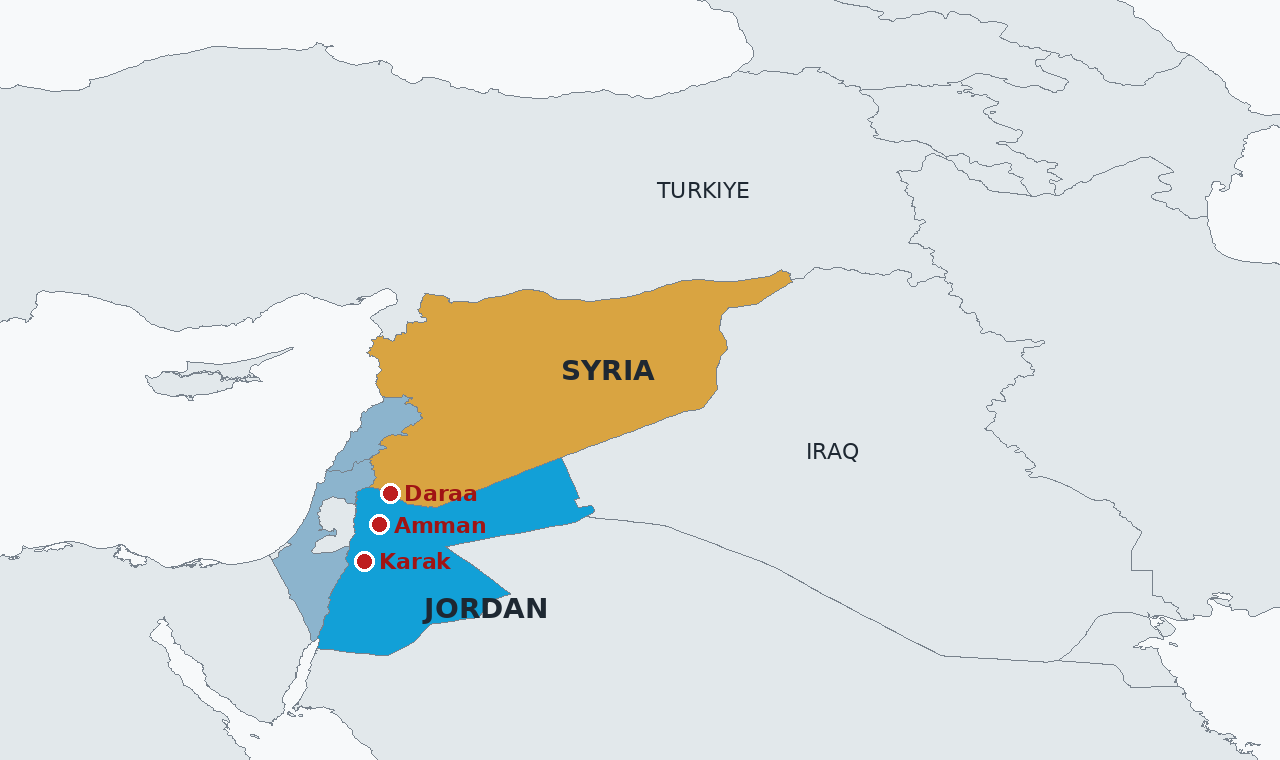
The jets went in on Monday evening, three days after gunmen opened fire on mourners at a Greek Orthodox church funeral in Karak and killed nine people. Jordan's armed forces say the air force struck hideouts used by armed groups in southern Syria that it blames for that attack, killing and wounding members of what it called terrorist groups and destroying several of their vehicles. Hours earlier, Jordanian security forces had arrested three suspects in Karak itself, all of them wounded in the shootout that ended the manhunt. Amman presents the two operations as one answer to one atrocity, delivered at home and across the border on the same day.
Syria tells the same night completely differently, and the gap between the versions is the story. Jordan says the operation was carried out in coordination with the Syrian government. Damascus says it was not: the strikes came without prior coordination or notification, an investigation has been opened, and a foreign ministry official called them a treacherous attack while promising to handle the fallout in a way that protected Syrian sovereignty. Syria's civil defence says its teams answered four strike sites in rural Daraa and Suweyda, and counted seven dead: five members of one family, three of them children, killed when a tent was hit at Al Tai, an 80 year old man at Al Shayyah and a 60 year old man at Shahba. Jordan has named no group, given no locations of its own and published no casualty figures, which leaves Syria's rescuers as the only people counting bodies in public.
Then Damascus reached for the one lever it holds. Syria's ports and customs authority closed the Nassib crossing, the only route for passengers and goods between the two countries, saying the shutdown protects travellers and border staff while the security situation in Daraa is assessed. A crossing that took years of diplomacy to reopen after the Syrian war is now shut by the side that was bombed, and every truck and family car that used it is part of the pressure on Amman to explain itself.
The pressures underneath run both ways. Jordan has lived for years with the traffic that crosses this border, militants, drugs and weapons moving through the same desert the funeral attackers are said to have come from, and a government that did not answer a massacre at a Christian funeral would have faced its own public. Syria's new rulers, meanwhile, are building a state whose first promise is that Syrian soil is no longer open ground for other people's wars, and absorbing a neighbour's airstrikes in silence would have priced that promise at nothing on its first serious test. Each capital did what its own audience required, and the coordination claim is where the two requirements collided: Amman needed the strikes to look agreed, Damascus needed them to look like a violation.
What happens next depends on a channel both sides say they have opened. Syria says communication lines with Amman are running so the circumstances can be established, which is diplomatic language for a negotiation about what Jordan does the next time it tracks attackers to the border. Jordan will want freedom to strike again. Syria will want warning, names and a protocol it can point to. The crossing stays closed until that conversation produces something Damascus can call respect for its sovereignty, because reopening it for free would tell every neighbour the price of bombing Syria is a difficult week.
Our call is that the crossing reopens within weeks, not months, because Jordanian trade and Syrian revenue both run through Nassib and neither capital can afford to keep it shut, but the coordination fiction does not survive. The next Jordanian strike on Syrian soil, and there will be one if the border traffic keeps producing attacks like Karak, will be preceded by a phone call Damascus can acknowledge, because Monday proved that the surprise itself is what converts a security operation into a sovereignty crisis. Amman keeps its deterrent, Damascus gets its protocol, and the family in the tent at Al Tai is the reason the protocol will be written in public this time rather than assumed in private.
The Briefing
The day's world, market and sport, measured and in your inbox before breakfast. One email, no noise, free while we build it.
Subscribe by emailSubscribing opens your email app with a note to [email protected]. We never share your address.