Three sea drones sank a container ship in NATO's sea, and nobody has claimed them
The Contship Jet went down off Bulgaria on Wednesday night with 421 containers aboard. All 18 crew were rescued, and she is at least the sixth ship attacked off the Bulgarian coast this month.
Varna, Bulgaria · October 29, 2026
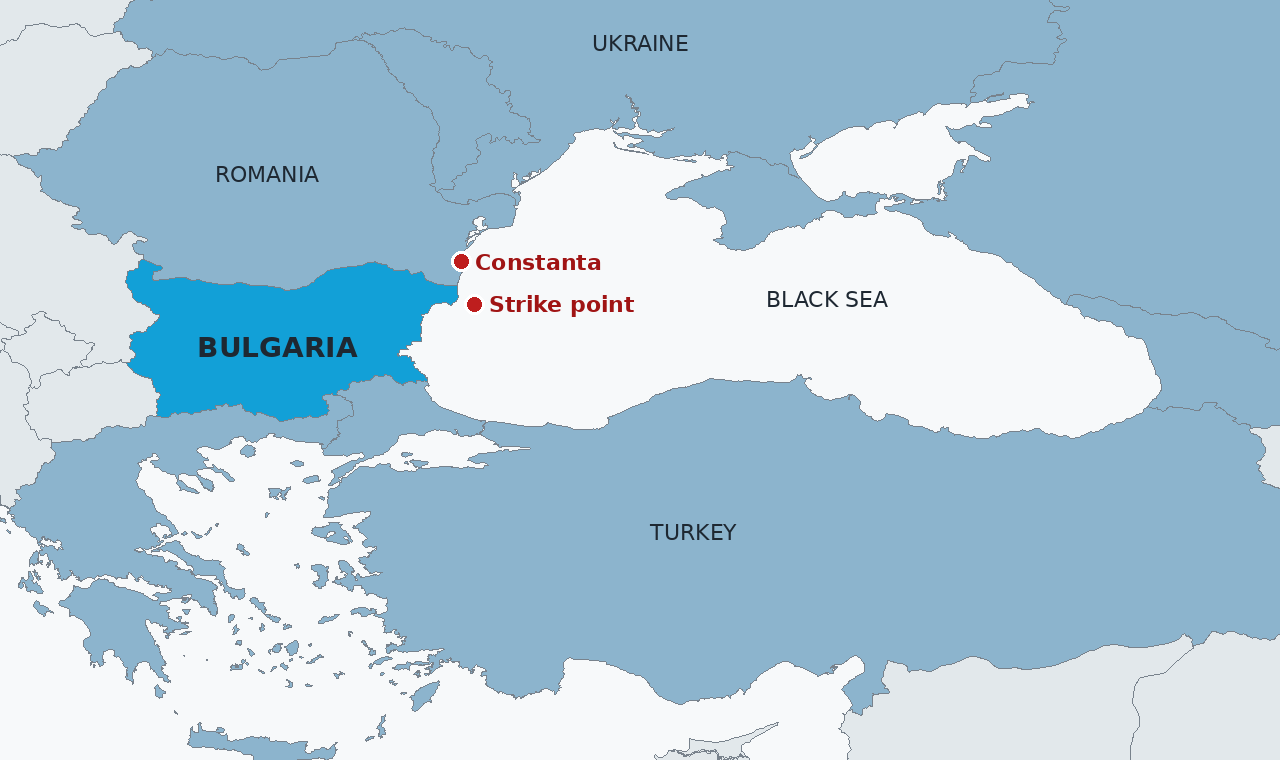
A container ship does not expect to be hunted in the waters of a NATO member, but that is what the western Black Sea has become. The Contship Jet, a Liberian flagged, Greek managed container ship carrying 421 containers from Haifa in Israel to Constanta in Romania, was hit by three sea drones on Wednesday as she passed through Bulgaria's exclusive economic zone, outside its territorial waters but inside the area Sofia is responsible for policing. She sank around midnight. Her crew of 14 Filipinos and four Ukrainians were all rescued and brought to Varna, and inspections on Thursday found no visible pollution, even though her cargo included lithium ion batteries, corrosive liquids and acids alongside industrial components.
She was not the first, and that is the part that should worry shipping far beyond Bulgaria. The Bulgarian government says at least six ships have been attacked off its coast this month, and about two dozen seafarers are feared dead across those attacks. Bulgaria's naval commander, Kiril Mihaylov, told national television that a French patrol aircraft had alerted Bulgarian forces to a possible drone attack and they had still been unable to prevent it. Read that sentence again, because it carries the whole problem: a warning arrived, from an ally, in time, and the drones got through anyway. Small, low, expendable sea drones are very hard to stop from a standing start, and everyone operating in that sea now knows it.
Nobody has claimed the attack, and Reuters reported that it was not immediately clear who carried it out. The timing, though, was loud. While the ship was being hit, the defence ministers of Bulgaria, Romania and Turkey were meeting in Sofia for trilateral talks on Black Sea security. Defence Minister Stoyanov condemned the attacks there, and the three countries agreed on stronger intelligence sharing. That is a real step and also an admission: three NATO members on one sea concluded that their problem is seeing the threat in time, which is what you agree to fix when shooting it down has already failed in public.
Why this is happening now sits underneath the geography. Russia's war in Ukraine has spent years pushing risk outward from the front line, first to Ukrainian ports, then to grain corridors, then to the whole northern Black Sea. The western shore was supposed to be the safe side, the EU and NATO side, where a ship could load, sail and insure itself at something like normal prices. A campaign of unattributed strikes there, whoever is flying or sailing the drones, tests exactly that assumption. If insurers decide the Bulgarian and Romanian coast is a war zone in all but name, the cost lands on every cargo that moves through Constanta and Varna, and on the Ukrainian exports that route around their own blocked ports.
Our call is that this becomes a NATO escort and air defence argument within weeks, not a shipping story that fades. Bulgaria has already sought assistance to bolster security off its coast, and a member state that can show six attacks in a month, a sunken ship and a warning system that saw the blow coming and could not stop it has a strong case in Brussels and at NATO headquarters. Watch whether allied aircraft and ships start flying standing patrols over the western Black Sea rather than visiting ones, and whether war risk premiums for Constanta calls jump at the next renewal. If both happen, the drones will have done their strategic work whether or not anyone ever claims them: the safe shore will have been repriced as a front line.
The Briefing
The day's world, market and sport, measured and in your inbox before breakfast. One email, no noise, free while we build it.
Subscribe by emailSubscribing opens your email app with a note to [email protected]. We never share your address.