Warplanes against wildfires: Britain sends the RAF after its own burning summers
After its hottest summer on record, Britain will fit RAF Chinook helicopters and A400M transports to fight fires from the sky for the first time, with 45 million pounds for specialist teams and 25 million to restore peatland as a firebreak.
London, United Kingdom · October 22, 2026
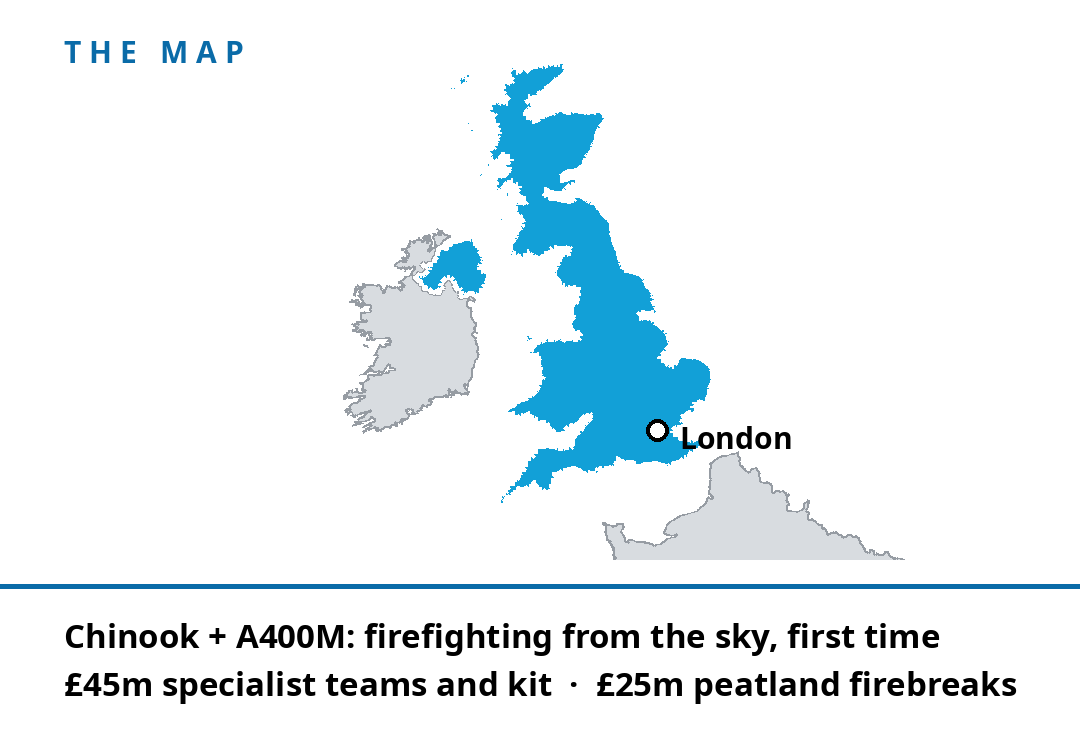
Britain's newest fire engines have wings. The government announced on Thursday that RAF Chinook helicopters and A400M transport aircraft will be equipped to fight wildfires from the sky, the first time the country has given itself a permanent aerial firefighting capability, with the aircraft available to support emergency services battling blazes in remote areas. A country that spent generations treating wildfire as somebody else's weather, a Mediterranean problem, has quietly admitted the map has moved.
The trigger was the summer just gone, the hottest on record, when heat the Met Office says climate change made around 130 times more likely left fire crews overwhelmed. The package around the aircraft runs wider than the headline. Up to 45 million pounds goes to specialist wildfire response teams and firefighter equipment, 25 million pounds goes into restoring peatland and supporting farmers to cut the risk at ground level, and a new AI unit will be set up to predict and track fires, working with the Met Office on forecasting and risk assessment.
Read the parts in order and the logic shows. The aircraft are the response, for the fire that has already started in a place a fire engine cannot reach. The peatland money is the prevention, because wet, restored peat resists burning in a way dried out moorland does not, and the AI unit and the forecasting work are the attempt to see the bad week coming before it arrives. Each layer covers the weakness of the one above it, which is what a strategy, rather than a press release, is supposed to look like.
What the announcement cannot do is shorten time. Equipping transport aircraft, training crews and standing up specialist teams takes seasons, not weeks, and the next hot summer will not wait for the programme timetable. Britain is also starting from a low base: it has historically borrowed aerial firefighting help and improvised, while countries that burn every year treat this fleet as ordinary infrastructure.
Our call is that the peatland line, the least glamorous 25 million in the package, is the part that decides whether this works. Aircraft can knock down the fires a hotter climate sends, and next summer's response times will be the first honest measure of the new capability. But a country that keeps restoring the ground that catches fire needs the aircraft less each decade, and a country that skips that work will need more of them every year. Britain has finally bought the planes. Whether it does the unglamorous digging is the story to watch.
The Briefing
The day's world, market and sport, measured and in your inbox before breakfast. One email, no noise, free while we build it.
Subscribe by emailSubscribing opens your email app with a note to [email protected]. We never share your address.