Algeria cut the Emirates off in a single day, then flew south to take back the Sahel
On September 10 Algiers severed five decades of ties with the UAE, gave its ambassador 48 hours to leave and closed its airspace the next morning. Within days its premier was in Bamako and its jets had already landed in Niamey. This was not a tantrum. It was a contest over who orders North Africa, fought by two countries with opposite ideas of how power works.
Algiers, Algeria · October 25, 2026
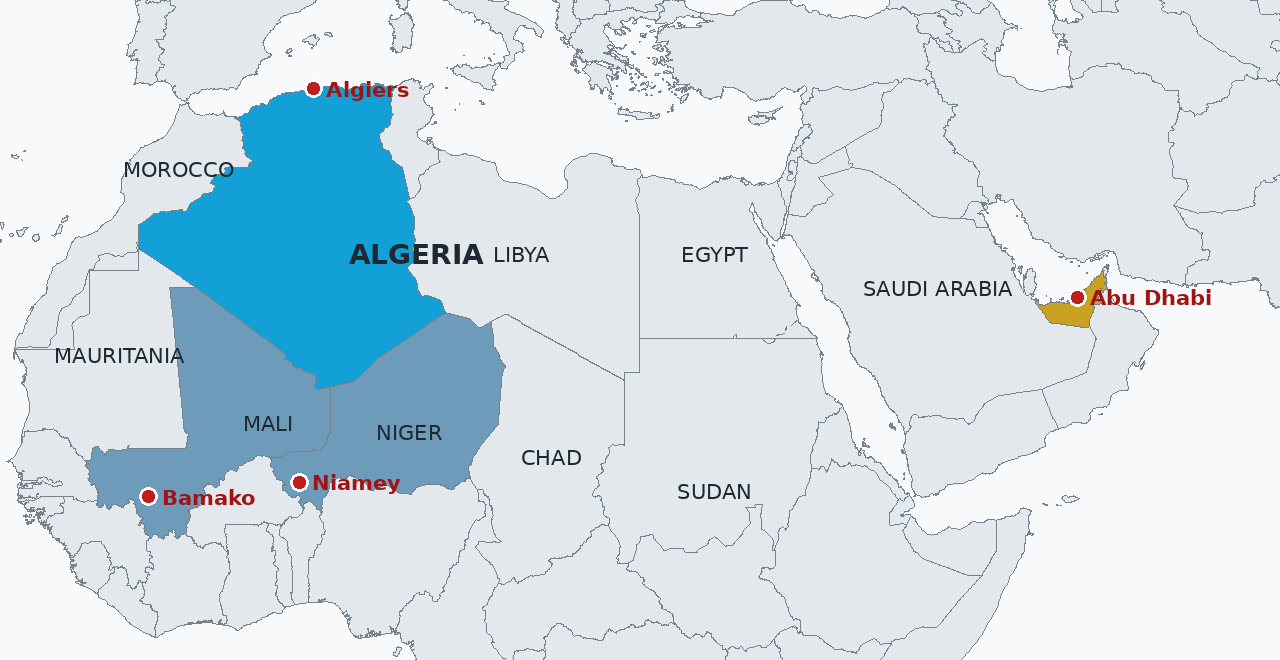
Fifty years of diplomatic relations ended on a Thursday. On September 10, Algeria's foreign ministry said it had severed ties with the United Arab Emirates, accusing Abu Dhabi of a series of provocative and hostile actions despite repeated warnings, and of exhausting every avenue that might have preserved the relationship. The Emirati ambassador, Yousef Saif Khamis Subaa Al-Ali, was summoned and given 48 hours to leave the country. From midnight on September 11, the defence ministry closed Algerian airspace to all UAE registered civilian and military aircraft. One door was left ajar on purpose: scheduled passenger flights to and from Algiers can keep running until the existing air services arrangements expire at the end of 2026.
Nobody who had been watching was surprised by the destination, only by the speed. Algeria had begun terminating its 2013 air services agreement with the Emirates back in February, after President Abdelmadjid Tebboune alleged attempted Emirati interference in Algerian elections. As far back as January 2024, the country's High Security Council had warned of hostile behaviour from a brotherly Arab country that everyone understood to mean the UAE. In July, Tebboune accused the Emirates of a destructive impact wherever they intervened. And on September 9, the eve of the break, Algeria's state news agency called Abu Dhabi the conductor of the region's crises. The next day the ties were cut.
Abu Dhabi answered the way a country answers when it wants the break to be temporary. Its foreign ministry expressed regret, stressed its commitment to preserving the relationship and said it hoped the decision would prove temporary, in a manner that preserves the fraternal ties between the two peoples. Anwar Gargash, diplomatic adviser to the Emirati president, posted that relations are managed through reason, communication and clarity of interests, not through riddles and hints that require decoding. Read together, the two capitals were not even arguing about the same thing. Algiers was announcing a verdict. Abu Dhabi was asking to see the charge sheet.
The charge sheet, as Algiers sees it, is a map. Algerian doctrine is old and rigid by design: sovereignty, territorial integrity, no outside proxies, and the Sahel's problems settled at a table in Algiers. Algeria brokered Mali's peace accord in 2015, and Bamako tore it up in January 2024. Against that state centred model stands the Emirati one, which works through networks rather than embassies: ports, gold, money and armed partners. In Libya, Abu Dhabi backs Khalifa Haftar in the east. In Sudan, a United Nations fact finding mission reported on September 1 that there were reasonable grounds to believe a transnational network running through the Emirates, among other countries, supplied the Rapid Support Forces with weapons, logistics, training and foreign fighters, with UAE linked persons and entities playing a significant role. The mission stopped short of attributing that conduct to the Emirati state itself, and Abu Dhabi denies involvement in Sudan's war, denials we set out in full in our earlier reporting on the case against Abu Dhabi. Over Western Sahara, the Emirates stand with Morocco, opening a consulate in Laayoune in 2020, against the independence Algeria champions. Algerian officials go further and accuse the Emirates of financing terrorist groups in the Sahel, an accusation Abu Dhabi rejects. Two orders, one region, and in Algiers' telling, room for only one.
What Algiers did next is what turns a rupture into a strategy. Days before the break, on August 30, Algeria sent four Su-30 fighter jets and a refuelling tanker to Niamey, at Niger's request, after a mutiny on August 28 and 29 attacked the air base, the state broadcaster and the presidential palace in the capital. The deployment was widely described as Algeria's first use of combat aircraft abroad since 1973. Then, on September 14, four days after cutting the Emirates off, Prime Minister Sifi Ghrieb flew to Bamako. It was the first visit by an Algerian premier to Mali since 2016. He carried Tebboune's invitation for Mali's leader, Assimi Goita, to visit Algeria, and Goita confirmed he was ready to come. The thaw had been building since July, when ambassadors returned and airspace reopened between the two neighbours after Algeria shot down a Malian drone near the border in April 2025, and Mali's prime minister visited Algiers on August 24. But the timing of the Bamako trip, in the same week as the rupture, was the message: the capital Abu Dhabi had just been expelled from intended to be replaced, in the Sahel, by Algiers itself.
There is a price for standing alone, and Algiers knows the figure. Emirati investment in Algeria is estimated at nearly 10 billion dollars, spread across ports, industry and defence plants, and the International Crisis Group has warned that the rupture could carry significant financial costs for Algeria for exactly that reason. The Emirates, for their part, lose a foothold and take a rare public rebuke, but nothing in the break touches their partners in Libya, Sudan or Morocco, and analysts note the two economies were never deeply dependent on each other. Mali and Niger gain a heavyweight patron at the moment West Africa's regional bloc keeps its distance from their juntas. Morocco gets to watch its two rivals fight. And France and the West, whose forces were pushed out of the Sahel capitals in recent years, watch the region reorganise without them.
Three paths run from here, and all three are genuinely open. The first is a quiet reset: the passenger flights keep a channel alive until December, Abu Dhabi's restrained response leaves room to climb down, and Algeria has just shown with Mali and Niger how fast it can repair a broken relationship when it wants to. The second is a hardening: Algiers anchors a bloc of Sahel juntas, the Emirates deepen their axis with Morocco, and two camps formalise across the Sahara. The third is escalation by proxy, in Libya and Sudan, where the two capitals already back opposite sides in live wars and where a rupture removes the diplomatic brake that used to sit on both.
Our call is that the December flight deadline, not the September headlines, is where this story gets decided, and that the Sahel realignment survives whatever happens to the embassies. Algiers built the exemption into its own ban, which means it built itself a clock: if the flights stop on December 31 with no talks announced, the break was meant to harden, and the Bamako and Niamey moves become the founding acts of an Algerian led bloc rather than a warning shot. If the exemption quietly extends, the rupture was leverage, priced and spent. Either way, the jets in Niamey and the premier in Bamako are not reversible gestures in the way an ambassador's expulsion is. Algeria has put aircraft and prestige into two junta capitals that will expect the patronage to continue, and a patron who walks away after that performance loses more than one who never performed. Watch the flight schedules in December, and watch whether Goita's visit to Algiers happens before them. Who blinks first matters less than who has already moved.
The Briefing
The day's world, market and sport, measured and in your inbox before breakfast. One email, no noise, free while we build it.
Subscribe by emailSubscribing opens your email app with a note to [email protected]. We never share your address.