France counts the cost of a weekend of unrest, and Macron tries to split the marchers from the wreckage
Officially 550,000 people marched across France on Saturday. By Sunday night the president was on television promising talks for the peaceful majority and prosecutions for the people who burned and looted, with an election six months away.
Paris, France · October 19, 2026
The region, on the map
Paris, France, pinned where this story happened, with every other place-led Indeks story.
See it on The Indeks MapStart with the scale, because this was not only a Paris story. The official count put Saturday's turnout at 550,000 people in scores of cities, from Lille and Strasbourg to Bordeaux, Lyon and Marseille. The CGT union federation put the figure at 800,000. Police planning had been built around about 200,000, with more than 10,000 officers deployed, so even a state braced for a bad day was outnumbered by its own country.
Most of those marchers went home peacefully, and that distinction is now the whole political argument. Running alongside the marches, masked groups set cars and buildings alight, ransacked shops and fought police. The interior minister put arrests across France at about 1,800, including a record 855 in Paris alone, and said more than 500 police officers were injured. One protester died in Paris after a cardiac arrest. Traders' unions say more than 1,500 shops and businesses were ransacked, at a cost in the tens of millions of euros.
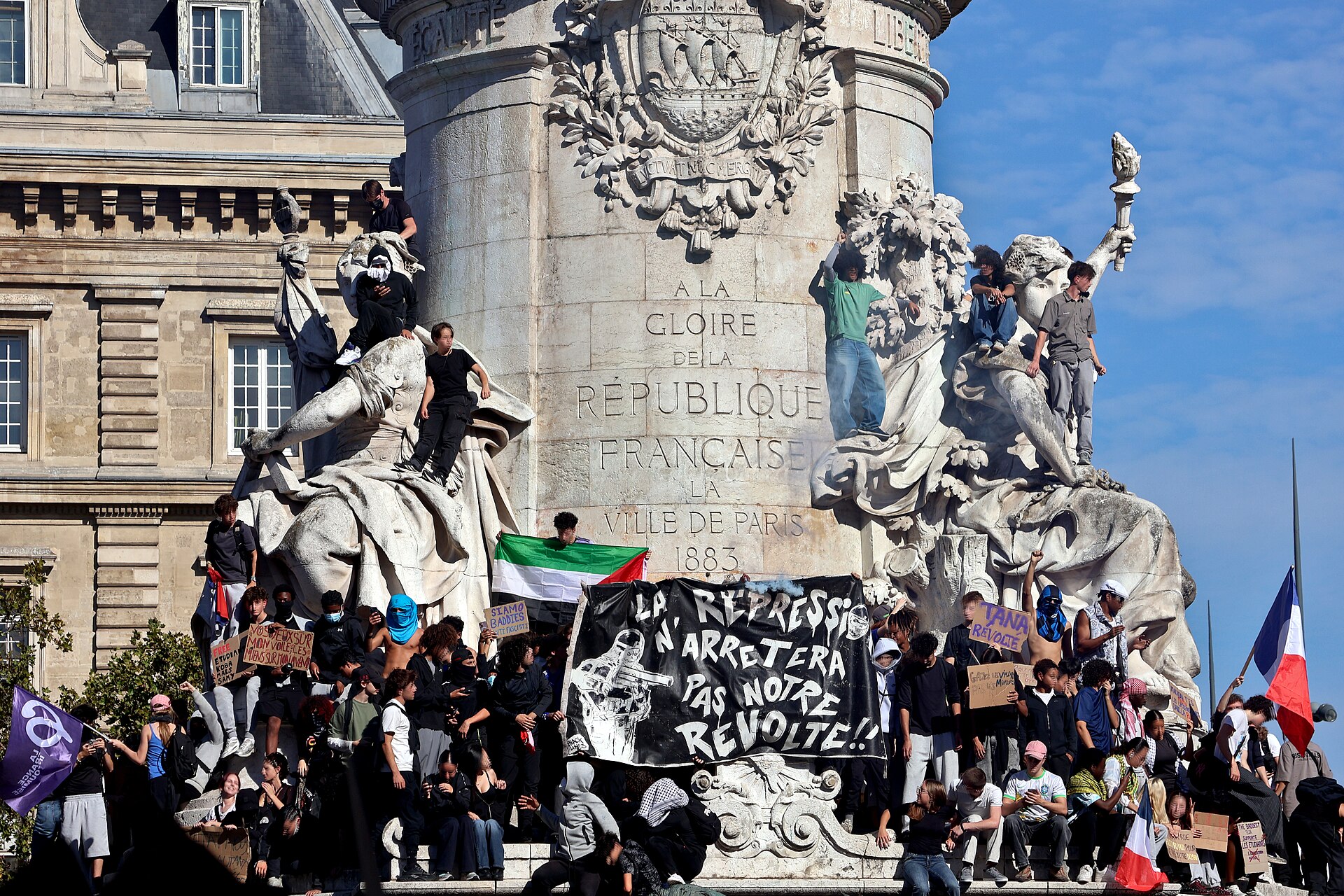
One town will stand for the weekend. In Limoges, in central France, the city hall was gutted by arson and its clock tower and roof collapsed. The building was 143 years old. In Marseille, groups stormed the city hall and a police station. In Bordeaux, a masked crowd got inside the prefect's residence, and the mayor said up to 100 shops were looted in that city alone. On Sunday there were fresh, smaller clashes at Place de la Republique in Paris while a cleanup ran from Lille to Marseille.
President Emmanuel Macron answered on television on Sunday evening. He said the country feels anger and shame, that nothing justifies the violence, and that people who looted and burned will face justice and pay for the damage. In the same address he called the marchers' demands legitimate, promised full transparency about the police response, ordered a review of police preparedness, and said he wants talks with students, teachers, unions and businesses. Prime Minister Sebastien Lecornu took the harder line, saying the government would not be intimidated and blaming the ultra left and criminals.
The movement behind Saturday did not start this weekend. It began in September as school protests over teacher shortages and poor conditions in working class suburbs, then widened over four weeks into cost of living, inequality and public spending cuts, with unions and Yellow Vest campaigners joining the students. That breadth is what makes it hard to settle. A government can fund teachers with one decision. It cannot answer five different grievances, carried by five different groups sharing one route, with one promise.
The timing does the rest. France elects a president in April and May 2027, and Macron is term limited, so he cannot run again. Marine Le Pen, whose party has placed itself on the side of the police, leads early first round polling, while Jean Luc Melenchon marched with the students and has called the government's handling of Saturday incompetent. Disorder helps the candidate selling order and anger helps the candidate selling anger. Watch the talks Lecornu holds with party representatives this week, and watch whether another national day of action gets called. Those two facts will say whether Saturday was a storm that passed or the election arriving early, in the street.
The Briefing
The day's world, market and sport, measured and in your inbox before breakfast. One email, no noise, free while we build it.
Subscribe by emailSubscribing opens your email app with a note to [email protected]. We never share your address.