Three new ghosts in Cassiopeia, found by staring for 100 hours
Three faint nebulae, glowing blue with ionised oxygen, have been found beside IC 59 and IC 63, the Ghosts of Cassiopeia, after 100 hours of observation through a special filter. One may be a star system's bow shock. Another may be a dying star's shell.
October 21, 2026
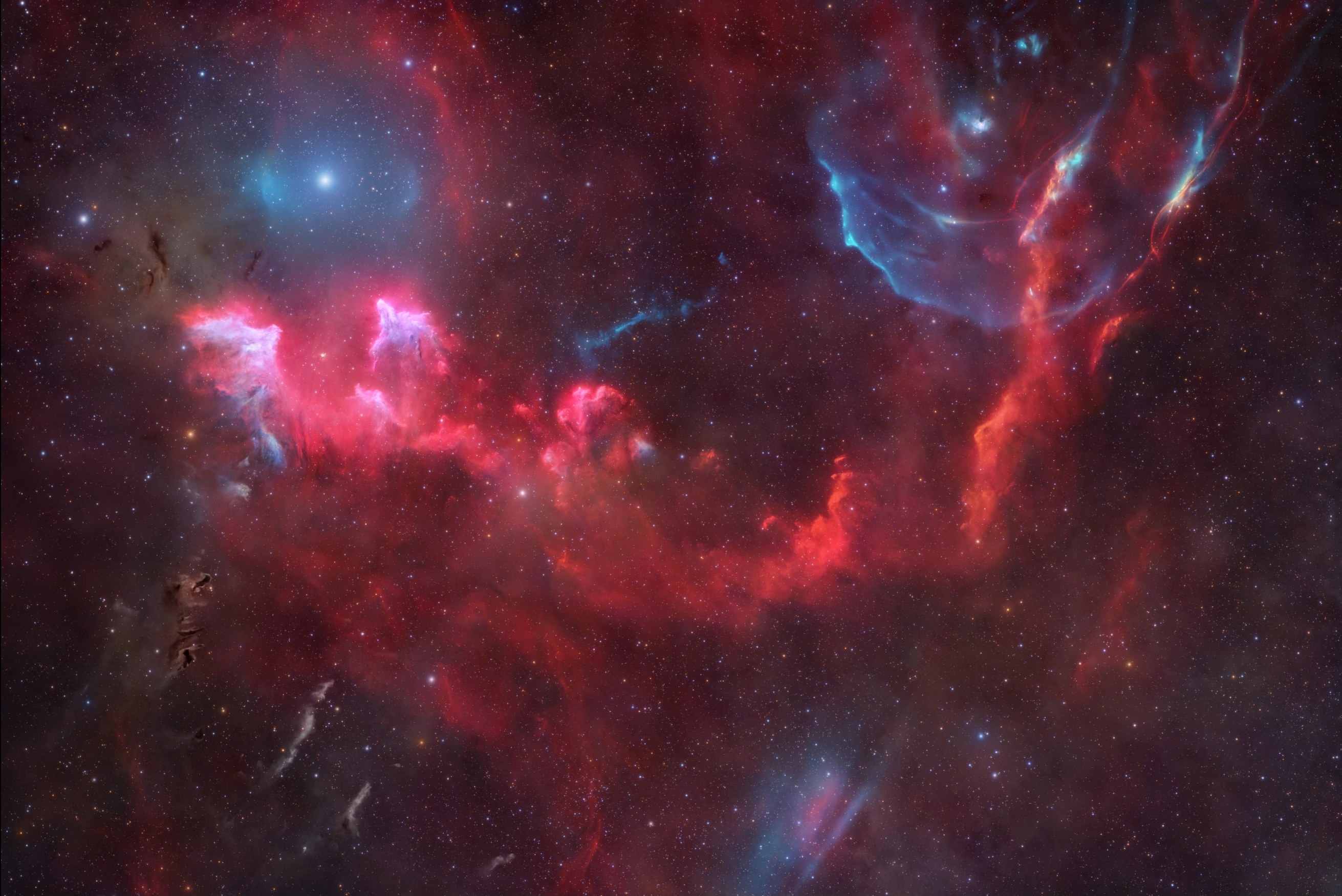
Some astronomical discoveries arrive with a telescope launch. This one arrived with patience. It took 100 hours of observation, and a special oxygen filter, to pull three faint nebulae out of the glare in the constellation Cassiopeia, where they had sat unnoticed beside two of the most photographed gas clouds in the northern sky.
The neighbours are famous. IC 59 and IC 63, the original Ghosts of Cassiopeia, float near the multi-star system Gamma Cassiopeiae, whose energetic light makes their hydrogen gas glow red while their dust reflects and scatters blue-white starlight. The new arrivals, catalogued for now simply as Objects 1, 2 and 3, show up as blue phantoms of a different chemistry: ionised oxygen. Nobody had seen them because almost nobody stares at one patch of sky for 100 hours through a filter tuned to oxygen.
Which raises the obvious question: ionised by what? The leading idea, set out by NASA's Astronomy Picture of the Day when it published the image on October 21, works like a boat. Gamma Cassiopeiae is ploughing through interstellar gas and dust, and material piles up at its bow the way water piles at the prow of a speeding ship. Object 3, on that reading, is the compressed and heated oxygen of the bow shock itself. Object 1 may be something else entirely, a planetary nebula, the shell of a dying star, if a central white dwarf can be found inside it. The team behind the image, four photographers working with Starfront Observatories, have left the origins formally open: a mystery, in NASA's words, to be solved.
There is a quiet lesson in how this was found. The big surveys map the sky fast and shallow. A small team with a narrow filter and a hundred hours to spend went deep instead, on a region professional astronomers considered well known, and came back with three objects that have no names yet.
Our call is that Object 1 decides whether this stays a beautiful footnote or becomes a catalogue entry that matters. If follow-up spectroscopy finds the white dwarf, Cassiopeia gains a planetary nebula hiding in plain sight beside its most famous ghosts, and every archive image of IC 59 and IC 63 gets re-examined for what else the glare was hiding. Expect that follow-up within the year, because a hundred hours of patience tends to attract a hundred more.
The Briefing
The day's world, market and sport, measured and in your inbox before breakfast. One email, no noise, free while we build it.
Subscribe by emailSubscribing opens your email app with a note to [email protected]. We never share your address.