130 hidden stars in one cloud: Webb opens up the nursery in Cepheus
Webb's infrared view of the stellar nursery NGC 7129, about 3,300 light years away, has revealed more than 130 stars in the earliest stages of life, most under a million years old, around a central star five to eight times the mass of the Sun.
October 22, 2026
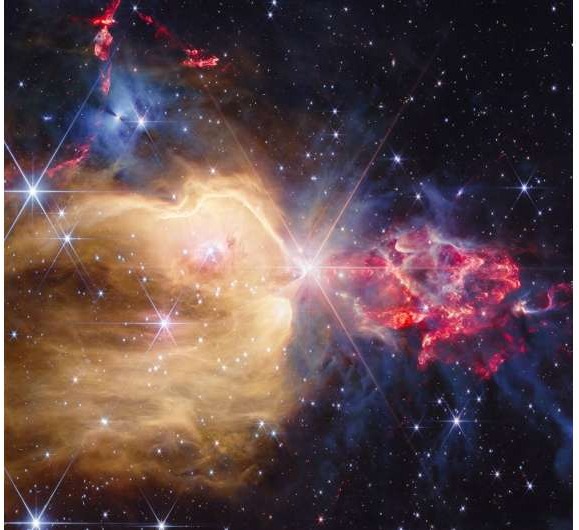
They were hidden by dust for as long as telescopes have looked. The James Webb Space Telescope's infrared view of NGC 7129, a stellar nursery about 3,300 light years away in the constellation Cepheus, sees straight through the cloud that blocked every earlier instrument, and inside it there are more than 130 stars in the early stages of life, most of them under a million years old. The image, released on October 6 from observations taken last December, is still giving up new detail two weeks on.
At the centre sits the reason the picture looks the way it does. LkHa 234 is a pre-main-sequence star of five to eight times the Sun's mass, largely finished gathering material but not yet fusing hydrogen the way a mature star does. While it was forming, its outflows carved a golden cavity about 3.5 light years wide into the cloud beside it. The gold is hot atomic hydrogen, gas heated until its molecules split apart. The red on the other side is cooler molecular hydrogen, shocked by outflows from protostars still buried in the dust. One frame holds the heat and the cold, the finished and the barely begun, side by side.
The part astronomers keep coming back to is the edges. The jets from these young stars slam into the surrounding gas and compress it into bow shocks and curved ridges, and compressed gas is where the next stars form. Star birth, in this image, is not a series of separate events. It is a chain reaction, each new star squeezing the cloud into making more, while the biggest of them blows a hole in the nursery and lights it from inside. A bright blue nebula in the corner is lit by another protostar wrapped in a torus shaped disk, a different stage of the same process caught in the same exposure.
There is a comparison that shows what changed. NASA's retired Spitzer telescope photographed this same region in infrared and saw a blur of filaments and glow. Webb's version resolves the filaments, separates the individual young stars and picks out background galaxies shining through the cloud behind them. Same patch of sky, same kind of light, an instrument a generation better, and a nursery that looked like a smudge turns out to hold a census.
Our call is that NGC 7129 becomes a reference image, the one reached for whenever a claim about triggered star formation needs a picture to stand on. The 130 count matters less than the arrangement: a massive star in the middle, a cavity it carved, shocked gas at the rim and infants at every stage in between is the theory of how star forming regions evolve, drawn in a single frame instead of argued across a dozen papers. The follow up work now is classification, sorting those 130 points of light by mass and age. Do that well, and this stops being a beautiful release image and becomes the baseline the next decade of nursery studies gets measured against.
The Briefing
The day's world, market and sport, measured and in your inbox before breakfast. One email, no noise, free while we build it.
Subscribe by emailSubscribing opens your email app with a note to [email protected]. We never share your address.