A flash from before the sun existed: Webb finds the home of the oldest fast radio burst
A millisecond of radio energy, detected in South Africa in March 2024, left its galaxy when the universe was about three billion years old. The James Webb Space Telescope has now found that galaxy, a tiny star forming dwarf about a thousandth of the expected size, and its smallness points at magnetars.
Sydney, Australia · October 23, 2026
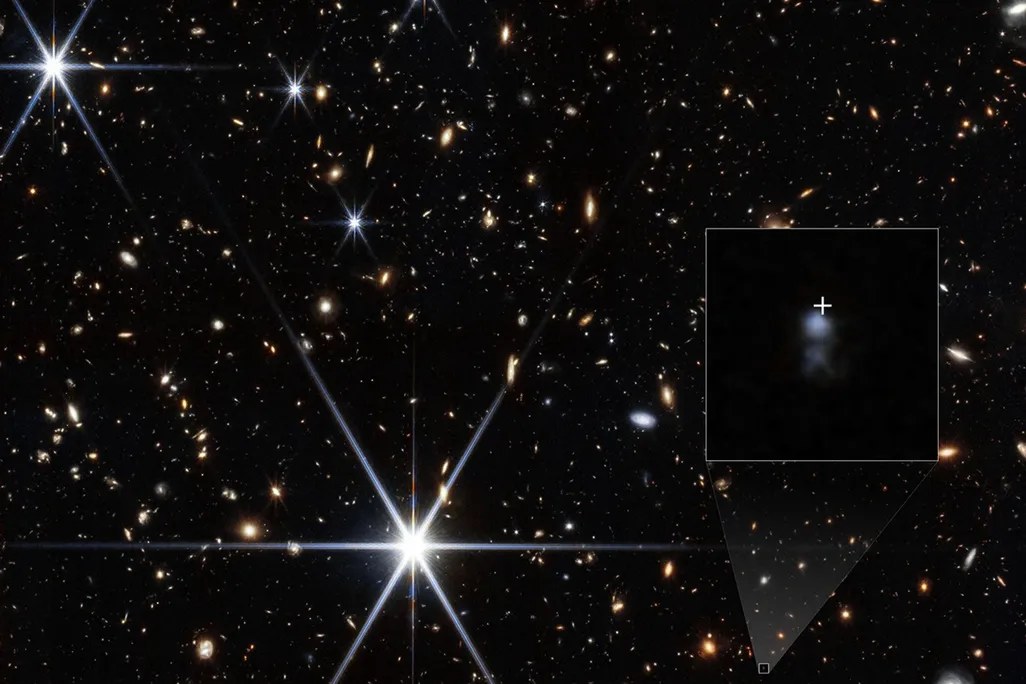
Start with the journey, because the journey is the discovery. In March 2024, the MeerKAT radio telescope array in South Africa caught a flash of radio energy that lasted a few milliseconds and then was gone, one of the strange, violent blips astronomers call fast radio bursts. The way its frequencies arrived smeared out in time said it had crossed an enormous amount of space to get here. When the James Webb Space Telescope was pointed at the spot, the largest ground based telescopes on Earth having stared at it and seen nothing, Webb found a galaxy: small, faint, and so distant that its light shows it as it was when the universe was about three billion years old. The burst, catalogued as FRB 20240304B and now published in the journal Science, is the most distant fast radio burst ever pinned to a home, more than doubling the previous record.
The team, led by Manisha Caleb at the University of Sydney, expected the home to be grand. A signal that old, the thinking went, would come from a big, well formed galaxy with lots of stars. Instead Webb measured a redshift of 2.148, a distance NASA puts at about 10.63 billion light years, and revealed a dwarf: a small galaxy, roughly a thousand times less massive than expected, low in heavy elements, and busily forming stars in the era astronomers call cosmic noon, when star formation across the universe was at its peak. We thought it would be a big, nicely formed galaxy, Caleb said, and instead it was a little dwarf galaxy, although it was actively forming stars.
That smallness is not a disappointment. It is evidence. Fast radio bursts have been a standing mystery since the first was found in 2007, with thousands detected since and two broad families of suspects: merging neutron stars, which need time to form, wander and collide, and magnetars, young neutron stars with the strongest magnetic fields known, which are born promptly when massive stars die. A burst fired when the universe was three billion years old, from a young, metal poor, star forming dwarf, fits the magnetar route far more comfortably. Young galaxies make young magnetars. They have not had the billions of quiet years that mergers ask for. As the researchers put it, the host's youth and chemistry are consistent with the burst coming from a magnetar, and the burst's age does the arguing.
There is a second gift inside the signal, beyond the whodunit. A burst that has travelled through about 80 percent of cosmic history has passed through all the thin, invisible matter strung between galaxies on the way, and its smeared arrival encodes how much of that matter it met. Distant bursts are, in effect, flashlights shone through the universe's missing inventory, letting astronomers weigh material that no telescope can see directly. Every new distance record is also a new measuring instrument, reaching further back.
Our call is that this result quietly ends the laziest version of the magnetar debate. It does not prove every fast radio burst is a magnetar, and the team is careful not to claim it does. But a burst this old, from a galaxy this young and small, is exactly the fossil the magnetar theory predicted and exactly the one the merger theory struggles to explain, and one clean fossil outweighs a hundred ambiguous ones. Expect the field's centre of gravity to shift now, from asking what these flashes are to using them, as probes of the early universe that happen to have told us, on the way past, where they were born.
The Briefing
The day's world, market and sport, measured and in your inbox before breakfast. One email, no noise, free while we build it.
Subscribe by emailSubscribing opens your email app with a note to [email protected]. We never share your address.